A new meaning of take-out. By Captain George Landrum. Los Cabos Magazine Issue #19 Winter 2009.
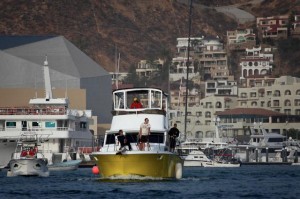 Striped Marlin are the fish that put Cabo San Lucas on the map as the “Marlin capital of the world.” Of course, there are large numbers of other fish out there to hook as well. In Cabo, we catch marlin all year-round, but they are considered as a sport or trophy fish by most anglers, and the large majority of the marlins caught are released. However, also year round, there is always something out there that goes well on the table. At the airport, either coming or going, it’s easy to spot fishermen. They’ve come to take their prized catches home for themselves and their friends to enjoy later, remembering the highlights of their trip, enjoying the fish they caught and cooked, savoring the rewards of their efforts.
In the summer, Cabo has Dorado (Mahi-Mahi), Yellowfin Tuna and Wahoo offshore, and Snapper and Grouper inshore. In the winter there are Yellowfin Tuna offshore, and Yellowtail and Sierra inshore. The fabulous Dorado is just about the perfect fish to cook any way you please. Tuna, Grouper and Sierra are great smoked or grilled. Wahoo is my favorite, but can turn out very dry if it is not prepared correctly. I like Wahoo and Yellowfin Tuna raw with a little Wasabi (Japanese horseradish) and soy sauce.
As recently as last year, mates on both charter boats and private boats would fillet the fish while at sea, returning the carcass and entrails to the ocean, continuing the cycle of life. This was done as a service to the client as the fillets could be bagged and placed on ice right away, preserving the fish in the best possible way. Unfortunately for everyone, the law specifically states that this can not be done. It is even printed right on your fishing license. In the past, heads have been turned away from the strict enforcement of this filleting practice, however, the Marines have recently become more stringent about the fishing laws in México. Boats that are found to have filleted fish on board can have all the fish confiscated, and all the fishing gear on the boat confiscated as well. A very hefty fine of up to $10,000 US may be imposed on the boat owner. Mates who are still willing to fillet the fish at sea can be sure that if the owner finds out about it they will not have jobs any longer.
Since you are not allowed to fillet at sea, you must be sure your catch stays in good condition during the fishing trip. The most important thing to remember is to keep the fish in a lowered temperature while at sea, and do not allow the temperature to rise up very much or for very long after that fish has been chilled. On many boats, the fish is kept in a fish box with a large chunk of ice. But as soon as the box is full, your fishing is over for the day; at least as far as keeping any more fish for eating is concerned. Many boats have fish boxes built into the transom where overflowing water from the bait tanks keeps the fish at water temperature, not allowing it to warm up under the hot sun. Not all charter boats have fish boxes large enough to hold more than 5 or 6 Dorado and Tuna, so anglers often bring along large coolers and buy extra bags of ice from the dock store on the way out of the marina. If the fish is placed in a cooler with ice, the ice should be packed on top of the fish so it can melt down around the fish and help cool it. Or if the box is large enough, salt water can be added to form extra-cool brine. Alternatively, if the fish goes into a transom fish box, the fish will bleed out there, the blood will go overboard, and thus the fish will not rise in temperature. When the fish is brought into the boat, it should be stunned as soon as possible and have a gill pulled to bleed it. On fish where the blood can heat up during a fight, such as Tuna, this is a vital step; otherwise the fish can “cook” from the inside out. If this happens, when the fish is ultimately filleted, the meat along the backbone will be white, soft and mushy instead of healthy and pink.
Wondering what you can do with the fish if you are not allowed to fillet them at sea? Some anglers think that they can go back to the hotel, fillet their fish in their room and then freeze the fillets in the room freezer. Do you really think any of these resorts want their guests doing this? Instead, there are a few options. In Cabo San Lucas, several of the larger fleets have personnel who will take the fish home, fillet and freeze them for you there and offer this service as part of the fishing package. Check with the Cabo Magic Sportfishing; Fly Hooker; Paradise Sportfishing; Picante; Pisces; Silverados Sportfishing; Top Anglers Sportfishing or Ursula’s Sportfishing fleets for information.
Fillets can be smoked at an additional cost. Gricelda’s Smokehouse, along the marina side of the Tesoro Los Cabos Hotel, will fillet, vacuum pack and freeze your fish in approximately one pound packages. Rates typically run $1.50 US per pound, finished weight. They can also smoke as much as you want at $5 US per pound finished weight, and then vacuum pack it in smaller portions. Your fish will be held there until you are ready to leave Cabo. If you just have one or two fish that you want for dinner while you are here, or if you just want Gricelda’s to fillet the fish and place the fillets in plastic bags, they charge $2 US per fish for smaller fish. Prices can vary based on how large the fish are. There are posted health certificates for the store and all employees. Their process uses reverse osmosis purified water, and the facility is air conditioned inside. The East Cape Smokehouse used to have a similar storefront operation on the other side of the marina, but it is no longer in business. The other alternative is the cleaning station near the main dock located at the weigh station. It is open air and uses city water for rinsing the tables. They will fillet your fish for between $2 and $50 each, depending on the size and species, and place your fillets in plastic bags for you. They do not freeze the fish there; that is left up to you. Most of the resorts have large freezers where you can store your fillets; after all, Cabo started as a fishing destination. If you do that, you need to make sure the bags are well marked and will not leak.
“How do I get my fish home?” is one of the most common questions I am asked after a successful trip at sea. Unfortunately, there is not a packing company that will ship for you. You must carry it home yourself. The airlines require that the fish be held in hard-sided plastic, or perhaps even metal, coolers, and that the fish be frozen solid. In the past, airlines have had bad experiences with raw fish leaking out of Styrofoam coolers, spilling blood all around the cargo area (or having frozen fish thawing out before it is loaded onto the plane and little pieces of Styrofoam blowing all over the jet way.) Plastic coolers are available everywhere in a large variety of sizes. With the new charges for extra baggage, many anglers are opting to buy coolers when they get here, thus avoiding the charge both ways. However, be aware that the cost of a supply and demand hard-sided cooler here can be equal to, or perhaps even more than the baggage cost.
I have had people bring me frozen salmon when they come down, vacuum packed and placed in interlocking closed-cell foam boxes that are in turn packed in heavy waxed cardboard boxes. They have taken fish home with them the same way. It works well, but in Cabo, no one offers this kind of packaging option.
If the fish is frozen rock-hard and kept insulated in the proper cooler, packed with extra clothing or newspaper around it, it will not spoil for several days. Keep in mind that the cargo holds are not pressurized, so the coolers are almost in a “deep-freeze” while stored there. Coolers must be available for inspection at the airport so do not duct-tape them before checking them in. And keep your fishing license. U.S. law states that it may be requested upon entering the country with fish that you claim to have caught, whether filleted or whole. This law is rarely enforced, but it pays to be prepared, just in case you are asked for it. If you say you bought the fish, you are required to have a receipt to prove it. With all the care of your fish after you have caught it, filleted it, smoked or frozen it, packed it and carried the coolers, you definitely want to ultimately savor the fruits of your trip’s bounty on your own table.