A look at the islands of the Sea of Cortés and how to explore them
By Ashley Alvarado
When it comes to Mexican states, Baja California Sur is still a baby. The former territory—home to Cabo San Lucas and San José del Cabo—didn’t achieve statehood until 1974. The Sea of Cortés, that magnificent body of water that separates the peninsula from mainland México, is also somewhat of a youngster. Geologists believe the peninsula was formed roughly 5.3 million years ago, after millions of years of violent earthquakes had separated Baja from the North American Plate and the Pacific Ocean eventually filled the void. That makes the Sea of Cortés—also known as the Gulf of California—the world’s youngest sea. Nevertheless, the Sea of Cortés is thought to be one of the most diverse on Earth. Humpbacks, gray whales, blue whales, orcas, manta rays, and leatherback turtles all make annual pilgrimages, while all year round you’ll find fin and sperm whales, as well as some 5,000 species of macroinvertebrates and the best sportfishing in the world. There are nearly 900 fish species alone, and 90 of them are endemic. The same volcanic activity that created the Sea of Cortés populated the gulf with 900 islands, 37 of them of measurable size. Here we highlight some of our favorite islands in the Southern Baja portion of the Sea of Cortés, those same islands that John Steinbeck made famous in his 1951 book Log from the Sea of Cortez.
Explore for Yourself
Cabo Expeditions (www.caboexpeditions .com.mx) offers two separate island-themed expeditions. The all-inclusive weeklong Sea of Cortez Islands Expedition journeys from Cabo San Lucas to Loreto (there is a Loreto-to-Cabo San Lucas itinerary available, too) and takes you to the same places Steinbeck visited in 1940: Espíritu Santo, La Partida, Los Islotes, San José Island, San Francisquito, Agua Verde, Danzante Island, Puerto Escondido, Isla del Carmen, Catalina Island, and Loreto. The base trip fee is $2,095 U.S. There is a mandatory $30 U.S. park fee as well as an optional one-way $158 U.S. fee for ground transfer. The second expedition is a one-day trip to the Espíritu Santo Archipelago, off the coast of La Paz. The day trip is great for ages 8 and up and begins with breakfast before travelers head out to Espíritu Santo for a fun-filled day that includes snorkeling with sea lions—there are 300 who reside in the Los Islotes sea lion colony—and a traditional seafood lunch on the beach. The trip costs $199 U.S. for adults and $137 U.S. for children 8 and older. Save 20 percent on Cabo Expeditions trips by booking online.
Coronado Island (Crown Island)
The five islands within the Loreto Bay National Marine Park are collectively known as Coronado Islands, although each has its own name. And the actual Coronado Island is pretty small and covered with picturesque white, sandy beaches and volcanic cacti. Come here to hike, snorkel, or dive. You’re less likely to encounter as many fellow travelers in this area, so you can have much of the vibrant sea life all to yourself. Depending on the time of year, you may spot sperm whales, blue whales, humpbacks, orcas, fin whales, and more while exploring these islands.
Isla del Carmen
What makes Isla del Carmen stand out? There are exquisite landscapes as well as plenty of flora and fauna. The beaches were made for swimming and exploring—the dolphins here are known for being unusually friendly—and the island itself has an interesting history that includes years in the salt business and conservation efforts to protect desert bighorn sheep.
Isla Danzante (Dancing Island)
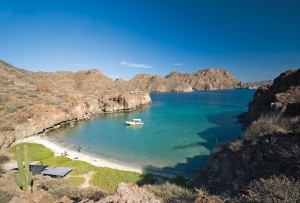
Off the coast of Loreto—the original capital of the Californias—you come across Danzante (pictured on opposite page); it’s the third of the Coronado Islands worth giving a special shout-out (you may also want to look up Catalina and Montserrat). From Loreto, you can arrange boat and kayaking tours of the islands, and I strongly suggest you do. Danzante is a particularly special island, which was once the gathering spot for several of the peninsula’s ancient tribes. This is where the Pericú, Guaycura, and Cochimí people would smoke peyote and dance to the gods and pray for rain. While there, visit Honeymoon Cove. It doesn’t take much imagination to figure out how it earned its name.
San José Island
Whales, birds, and those who love to watch them gravitate to San José Island, which is separated from the Baja Peninsula by a 17-mile-long channel lined with mangroves. The lush setting attracts beautiful wildlife in search of reprieve from the otherwise desert-like climate. Put down the binoculars to explore San José’s other attractions, which include ancient remnants from the Guaycura Indians and impressive cacti.
Espíritu Santo (Holy Spirit)
The United Nations Educational, Scientific and Cultural Organization (UNESCO) designated the archipelago collectively known as Espíritu Santo—the name of the largest island in the group—as well as 200 smaller islands as a World Heritage Site and biosphere because of their rich biodiversity and gorgeous scenery. The islands, which are located off the coast of the Southern Baja capital of La Paz, are surrounded by inviting azure waters that are teeming with life: There are whales, sea lions, dolphins, reefs, and several hundred fish species. In fact, UNESCO estimates that 39 percent of the world’s fish species live in these waters. That includes the largest fish of all, the whale shark, which you may see during the boat trip to or from Espíritu Santo.